01 · Context and stakes
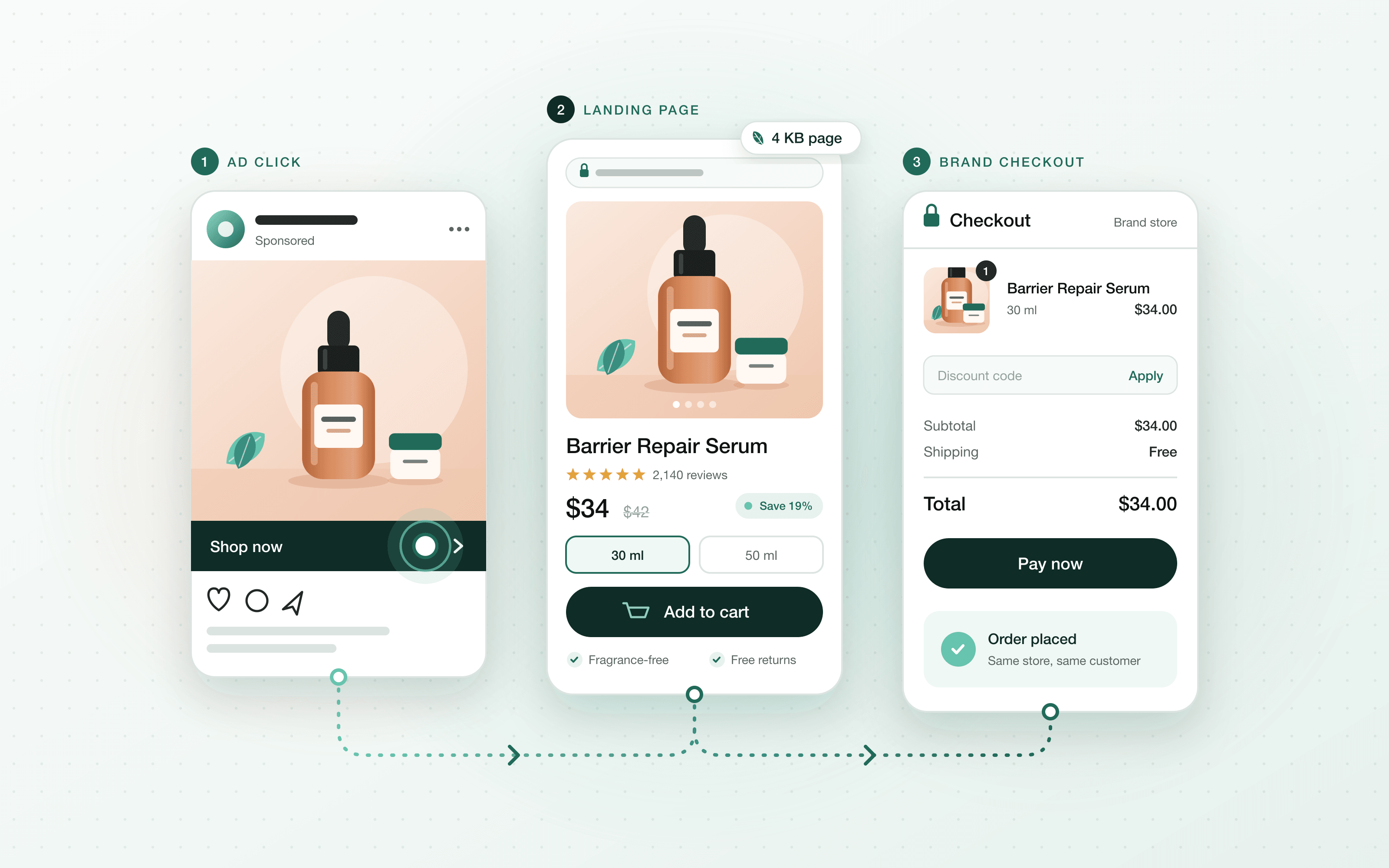
Nishe is a Toronto startup with a simple pitch: the fastest landing pages for ads. Brands running ads on Meta, TikTok and Google usually send that traffic to a product page, which is built for browsing a store, not for the one product the shopper just saw. Nishe gives each ad its own shoppable page, with the catalog synced from the brand's Shopify store, and hands checkout back to that store.
Nishe is about five years old and has been through a few pivots before landing pages for ads became the core product. Blackbird has been part of Nishe since its inception, and the product has been coded at Blackbird from the start.
Its leadership is lean: two co-founders, the CEO and the CTO. Our dev team works closely with the CTO. Together we chose the tech stack and set the technical direction, and over time built a flexible, fairly complex ecosystem that runs Nishe as a sales channel for Shopify.
The stakes follow from that. An ad landing page has one job: load before the shopper loses interest, then get them to checkout. Every extra kilobyte on a phone costs part of a click the brand has already paid for. And Nishe sits in the revenue path of every campaign, so a page that breaks is a click that can't convert.
02 · Constraints
- Pages have to load fast. For an ad landing page, load time is the product.
- Checkout stays with the brand. Orders go through the brand's own Shopify checkout and land in its Shopify admin.
- No theme edits. Nishe has to work alongside each store's existing theme and apps.
- A public Shopify app. Listing on the Shopify App Store means passing Shopify's review and continuing to meet its requirements.
- A product that changes direction. The platform had to carry Nishe through a few pivots with a lean team behind it.
03 · Through Shopify's app review
We built Nishe's Shopify app, launched it, and took it through Shopify's app review with the Shopify team. That is a different job from building a custom app. A custom (private) app made for a single store doesn't need review. A public app listed on the Shopify App Store does, and Shopify's review is thorough: their team tests the app against Shopify's requirements, from installation and the permissions it asks for to how it handles merchant data, and sends back anything that has to change before it can be listed. Getting through it takes knowing those requirements before writing the code, not after. Nishe is listed on the Shopify App Store.
04 · Outcome
Nishe reports a significant conversion lift over traditional destination pages. Where brands send ad traffic to a Nishe page instead of a product page, Nishe's measurements show conversion 50% to 150% higher. The platform is live, and we keep building and running it.
05 · Architecture
Landing pages. Nishe's pages run on an internal framework built for Nishe, with no heavy front-end framework. They are plain JavaScript and CSS with a minimal payload; some pages are only a few kilobytes. They are served from the edge on AWS CloudFront and Cloudflare, close to the shopper, which is what makes them load fast.
Backend. The backend is distributed through edge workers too, so the requests behind a page are handled near the shopper rather than in one distant region.
Shopify. A public Shopify app and sales channel. Brands install it from the Shopify App Store and approve its access. Products, collections, inventory and pricing sync from the brand's store, and checkout hands off to the brand's own Shopify checkout, so orders and customer records land in the brand's Shopify admin.
Stack. A mix of Java and TypeScript, predominantly TypeScript.
Shopper path
Ad
Meta ad
TikTok ad
Google ad
Down to Edge, via: Ad click
Edge
Nishe landing pageServed at the edge
Plain JavaScript and CSS; some pages a few kilobytes
Down to Brand's store, via: Checkout handoff
Brand's store
Shopify checkout
In the brand's own store
Shopify admin
Orders and customer records
Platform (our build)
Pages
Nishe's own framework
No heavy front-end framework, minimal payload
Down to Backend.
Backend
Edge-distributed backend
Edge workers on AWS CloudFront and Cloudflare
TypeScript and Java
Predominantly TypeScript
Down to Shopify, via: Shopify APIs, access approved by the brand
Shopify
Public Shopify appShopify Approved
Sales channel
Catalog synced from the brand's store
Brand
Install
Shopify App Store
Brand installs Nishe and approves its access
Down to Store, via: Products, collections, inventory, pricing
Store
Brand's Shopify store
Catalog, checkout, orders
An ad click lands on a page served from the edge, and checkout happens in the brand's own Shopify store. 06 · Decisions
A Shopify sales channel, with checkout in the brand's store
- Considered
- A standalone storefront with its own checkout; pages built inside each merchant's theme; a Shopify sales channel.
- Chose
- A Shopify sales channel. Nishe's pages sell the brand's Shopify catalog and hand checkout back to the brand's own Shopify store.
- Why
- Brands keep their checkout, payments, orders and customer records where they already are, and Nishe never has to edit their theme.
- Trade-off
- Nishe depends on Shopify's APIs and platform rules, and has to follow them as Shopify changes them.
A public app through Shopify's review, not custom apps
- Considered
- A custom app set up for each brand's store; a public app listed on the Shopify App Store.
- Chose
- A public app, built to Shopify's requirements and taken through their app review.
- Why
- Any Shopify brand can find and install Nishe from the App Store themselves, without a per-store setup.
- Trade-off
- A thorough review before listing, and Shopify's requirements to keep meeting as the app changes.
Our own minimal framework for landing pages
- Considered
- A popular front-end framework; a page builder's standard output; a minimal internal framework.
- Chose
- An internal framework specific to Nishe: plain JavaScript and CSS, minimal payload.
- Why
- For an ad landing page, every kilobyte counts. Some Nishe pages are only a few kilobytes, which a heavy framework can't match.
- Trade-off
- We maintain the framework ourselves, there are fewer off-the-shelf components, and new engineers learn Nishe's conventions first.
Pages and backend at the edge
- Considered
- Pages and backend in one cloud region; pages at the edge with a central backend; both distributed through edge workers.
- Chose
- Pages and backend both distributed through edge workers on AWS CloudFront and Cloudflare.
- Why
- Shoppers are wherever the ads run. Serving from close to them keeps load times low for every page, not only the ones near a data center.
- Trade-off
- Edge runtimes are more constrained than servers, and distributed code is harder to debug and observe.
07 · Security
Shopper payments stay in the brand's checkout
Shoppers pay in the brand's own Shopify checkout, so Nishe never handles their card details.
Brands own orders and customer data
Orders and customer records created through Nishe land in the brand's own Shopify admin.
Access granted by the brand
Brands install Nishe through Shopify's authorization flow and approve the access it asks for. Uninstalling the app removes it.
Reviewed by Shopify
As a public app, Nishe passed Shopify's app review before it was listed on the Shopify App Store.
Minimal code in the shopper's browser
Pages are plain JavaScript and CSS on Nishe's own framework, with no heavy third-party front-end framework.
08 · Delivery
1. From inception. We joined Nishe at the start and, with the CTO, chose the stack and the technical direction.
2. The Shopify app. We built the app and sales channel, launched it, and took it through Shopify's app review. It is listed on the Shopify App Store.
3. Through the pivots. As Nishe went through its pivots and landing pages for ads became the core product, the platform grew into the flexible ecosystem it is today.
4. Pages built to load fast. We built Nishe's own landing-page framework and moved pages and backend onto edge workers on AWS CloudFront and Cloudflare.
5. Today. The project is active. We keep building and running the platform with Nishe's CTO.
09 · Results
Conversion versus product pages
Nishe's data
50% to 150% higher where a Nishe page is the ad's destination, per Nishe's measurements
Landing-page weight
live today
Some pages only a few kilobytes: plain JavaScript and CSS, served from the edge
Shopify App Store
live today
Public app, through Shopify's app review and listed
Engagement
since Nishe's inception, ongoing
Building and running the platform alongside Nishe's CTO
- Part of Nishe since its inception, setting the stack and technical direction with its CTO.
- Built Nishe's public Shopify app and took it through Shopify's app review to a listing on the Shopify App Store.
- Landing pages as small as a few kilobytes, with pages and backend served from the edge on AWS CloudFront and Cloudflare.
- Nishe reports conversion 50% to 150% higher than product pages where its pages are the ad's destination.
10 · Team
Nishe's leadership is its two co-founders, the CEO and the CTO. Our dev team works closely with the CTO, as it has since day one.
Who owned what: Nishe owns the product, the business, its relationships with brands and the measurement of their results. Technical direction is shared: the CTO and our team set the stack and architecture together. We build and run the platform: the landing-page framework, the edge backend, and the Shopify app and sales channel.